One Venue. Three Carriers. Three Very Different User Experiences.
How to Compare Carrier Performance
When venue operators evaluate wireless performance, the focus is often on whether the Distributed Antenna System (DAS) is operational or whether WiFi coverage is available throughout the building.
But there is a much bigger question that often goes unanswered:
How well is each carrier actually performing for your users?
In modern venues, whether it’s a stadium, airport, hospital, convention centre, or commercial building, visitors don’t all use the same network. Some rely on AT&T. Others use Verizon. Others use T-Mobile. Each carrier operates on different spectrum bands, network configurations, and deployment strategies.
As a result, the user experience can vary dramatically from one carrier to another, even within the same venue.
This is why multi-carrier testing has become a critical requirement for organizations that want complete visibility into wireless performance.
The Problem with Traditional Testing
Many wireless testing solutions focus on a single carrier or provide only a snapshot of network performance at a specific point in time.
While this can identify isolated issues, it doesn’t provide a complete picture of the wireless environment.
For example:
- AT&T users may experience excellent 5G performance in one area of the venue.
- Verizon users may have stronger coverage but lower throughput.
- T-Mobile users may perform exceptionally well on specific spectrum bands but struggle in congested areas.
Without continuous multi-carrier testing, these differences often remain hidden until users begin reporting problems.
By then, troubleshooting becomes reactive rather than proactive.
Why Carrier Performance Matters
Today’s venues rely on wireless connectivity more than ever before.
Fans are streaming live video and sharing content on social media.
Healthcare professionals depend on mobile communications and connected devices.
Airport passengers expect uninterrupted access to travel apps and services.
Corporate tenants rely on mobile connectivity for critical business operations.
When wireless performance degrades, the impact extends beyond user frustration.
It can affect:
- Customer satisfaction
- Operational efficiency
- Revenue generation
- Brand reputation
- Service level agreements
To truly understand wireless performance, venue operators need visibility into how each carrier is performing at any given moment.
The AirScan Approach to Multi-Carrier Testing
AirScan was designed to provide a complete view of carrier performance from the end-user perspective.
Using a multi-carrier SIM solution, AirScan continuously cycles through AT&T, Verizon, and T-Mobile, performing the same tests a real mobile user would experience throughout the day.
Rather than relying solely on infrastructure alarms or carrier reports, AirScan actively tests each network and records performance metrics in real time.
This includes:
- RF measurements
- Signal strength testing
- Signal quality analysis
- Band scan testing
- Throughput and speed tests
- Network availability monitoring
- DNS resolution testing
- Connectivity validation
- Carrier-specific performance metrics
Because AirScan continuously evaluates each carrier independently, operators gain a much deeper understanding of the actual wireless experience within their venue.
Compare Carriers Side-by-Side
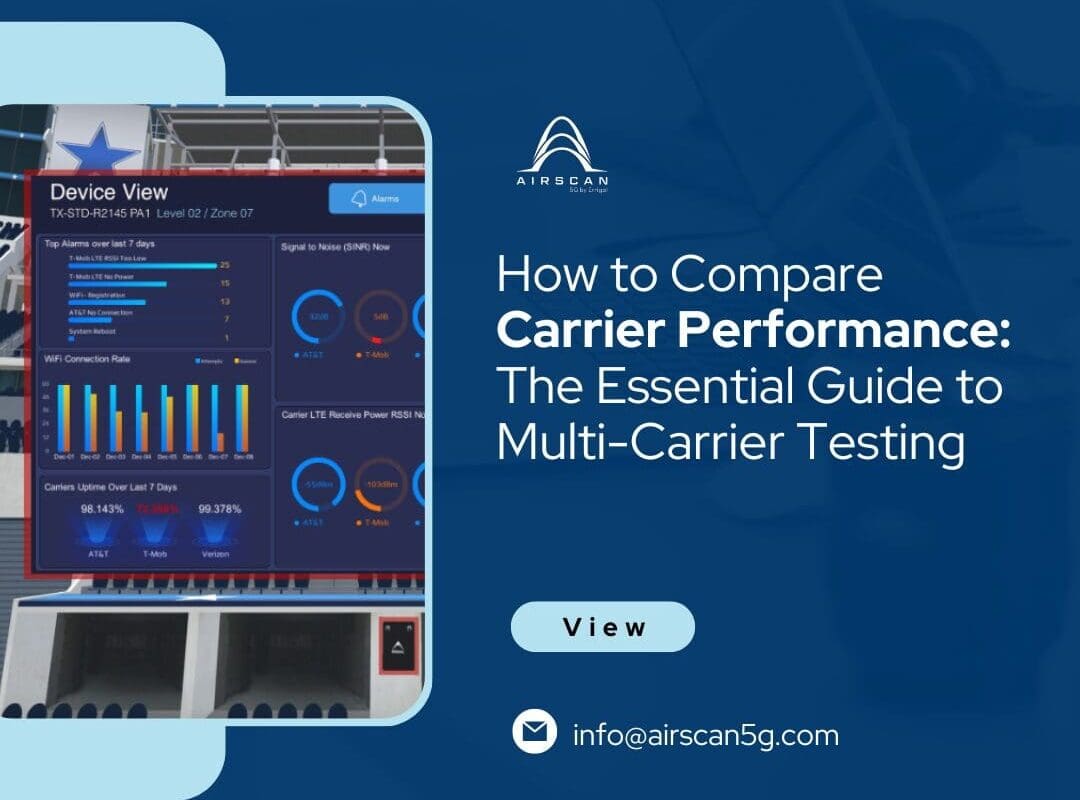
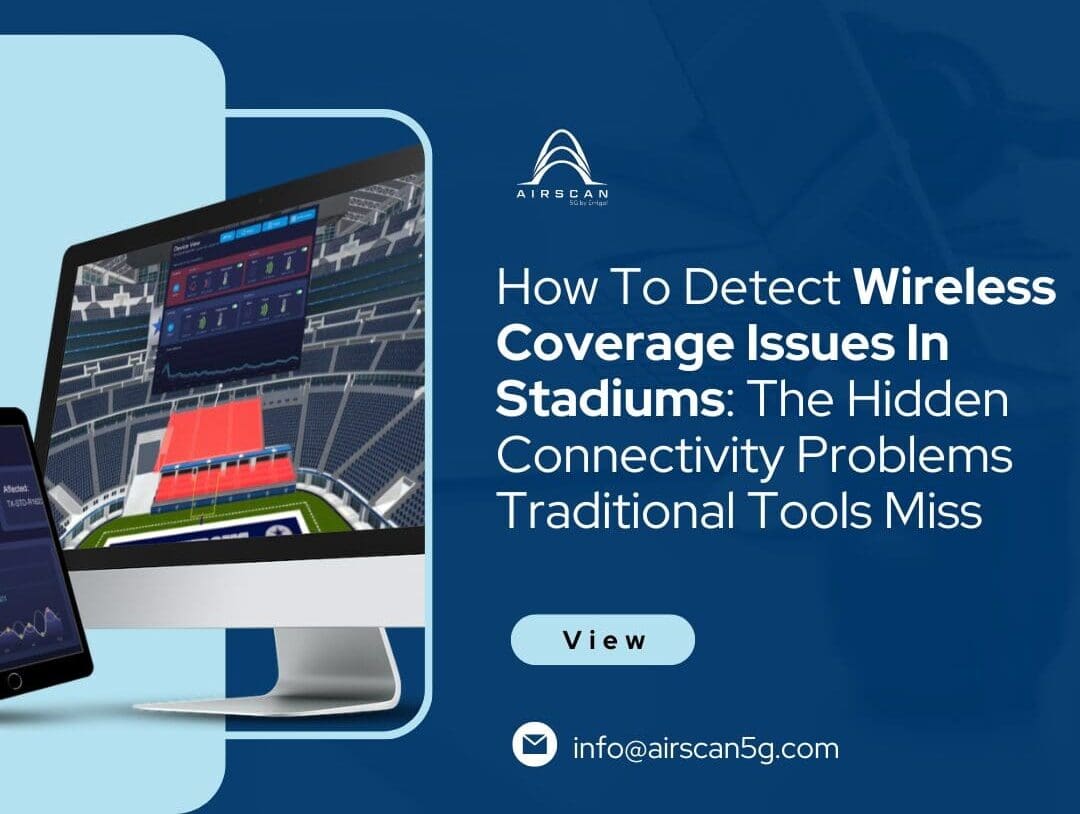
One of the most powerful capabilities of AirScan is the ability to compare carrier performance within a single dashboard.
Instead of reviewing separate reports from multiple operators, AirScan presents all carrier data in one place.
This allows teams to:
- Compare AT&T, Verizon, and T-Mobile performance side-by-side
- Identify which carrier performs best in specific areas
- Analyze carrier performance across different time periods
- Compare 4G and 5G network performance
- Detect carrier-specific degradation before users notice
- Validate improvements after network changes
Most importantly, operators can cross-reference carrier performance against each other to identify patterns that would otherwise be difficult to detect.
Understanding Band-Level Performance
Not all wireless spectrum performs the same way.
Different carriers utilize different frequency bands to deliver coverage and capacity throughout a venue.
Some bands provide stronger indoor penetration.
Others deliver higher throughput but may be more susceptible to congestion.
AirScan’s band scan capabilities provide visibility into how individual carriers perform across different spectrum bands.
This enables operators to answer questions such as:
- Which carrier performs best on 4G LTE bands?
- Which carrier delivers the strongest 5G experience?
- Are certain bands underperforming during peak periods?
- Are specific carriers experiencing congestion on particular frequencies?
- Which areas of the venue require optimization?
By understanding performance at the band level, venue owners and operators can make more informed decisions about network improvements and carrier discussions.
Turning Data into Action
The value of multi-carrier testing goes beyond monitoring.
The data generated by AirScan helps organizations:
- Validate carrier performance claims
- Support SLA discussions
- Identify underperforming coverage zones
- Detect performance degradation early
- Prioritize RF optimization projects
- Improve user experience across the venue
Instead of relying on assumptions or isolated user complaints, operators gain objective data that supports faster and more informed decision-making.
The Future of Venue Connectivity
As wireless networks continue to evolve, expectations around connectivity will only increase.
Users expect fast, reliable service regardless of their carrier.
Venue operators need visibility into network performance across all providers, not just one.
Multi-carrier testing provides the insight required to meet those expectations.
By continuously testing AT&T, Verizon, and T-Mobile from a single platform, AirScan delivers a complete view of wireless performance across the venue.
Because when it comes to connectivity, success isn’t measured by whether the network is online.
It’s measured by the experience every user receives, regardless of the carrier they choose.